
By the end of a single summer, the wrong setting will tell on itself. Cushions fade, timber dries out, woven finishes go brittle, and what looked polished in a showroom starts to feel tired under real Australian conditions. Choosing outdoor furniture for Australian sun is less about chasing a look in isolation and more about selecting pieces engineered for heat, UV exposure, sudden rain and long afternoons of use. That decision sits at the intersection of aesthetics and performance. The furniture has to belong to the architecture, suit the way you entertain, and still hold its line after years on a terrace, beside a pool or on a coastal balcony. That is where material quality, construction standards and considered planning make all the difference.
What Australian sun really does to outdoor furniture
Australian light is beautiful, but it is uncompromising. Intense UV can bleach fabric, weaken lower-grade synthetics and accelerate the breakdown of finishes that were never designed for prolonged exposure. Add radiant heat from paving, salt in coastal air, afternoon storms and seasonal humidity, and you have conditions that quickly expose shortcuts in manufacturing.
This is why two pieces can appear similar at first glance yet age very differently. Properly prepared teak, outdoor-rated upholstery and premium weaving fibres will simply perform better than alternatives where the underlying construction has been compromised.
Designing specifically for these conditions has been part of Osier Belle’s approach from the beginning. The brand was founded after Penelope Camplisson identified a gap for luxury outdoor furniture designed around Australia’s demanding climate, with particular attention paid to structural frames, cushion construction, outdoor fabrics and weaving materials.
There is also a comfort factor that often gets overlooked. Some materials become uncomfortably hot in direct sun. Some dark fabrics absorb more heat than expected. Deep seating may feel inviting in a showroom, but if proportions are wrong for the space or the climate, it can feel heavy rather than relaxed. Good outdoor design accounts for how furniture looks at noon in January, not just how it photographs.
The best materials for outdoor furniture for Australian sun
Material selection should never be reduced to a single “best” answer because it depends on location, exposure and the visual language of the home. What works beautifully in a protected courtyard may not be the right choice for a fully exposed beachfront deck.
Teak for warmth and long-term character
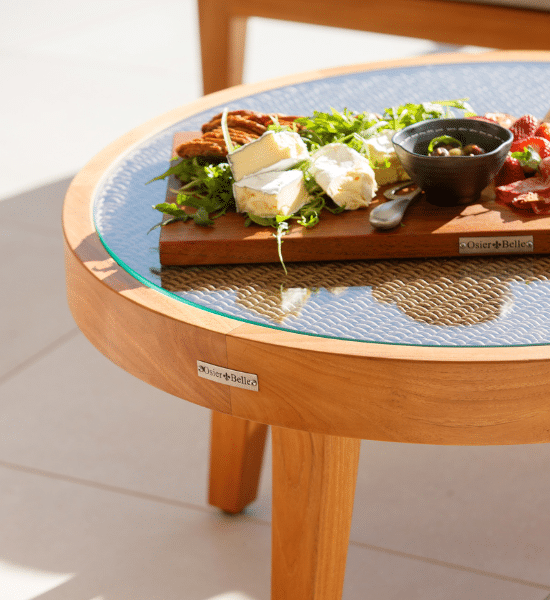
Teak remains one of the most respected materials for outdoor living because it is naturally durable, structurally stable and visually refined. In strong sun, quality teak performs exceptionally well, provided it has been properly sourced, prepared and constructed. It can be left to weather into a soft silver-grey or maintained to preserve its warmer tone.
At Osier Belle, the teak itself is given as much consideration as the finished design. The brand sources quality teak from Jepara, Indonesia, which is selected before being kiln-dried to an equilibrium moisture content below 12%. Osier Belle’s teak furniture is also sealed with Cutek before leaving production, rather than supplying raw timber and leaving that initial protection to the homeowner.
The trade-off is that teak is a living material. It will respond to its environment and develop character over time. For many clients, that is part of its appeal. In architectural settings where texture and natural variation are welcome, teak brings depth that more uniform materials cannot replicate.
Synthetic wicker done properly
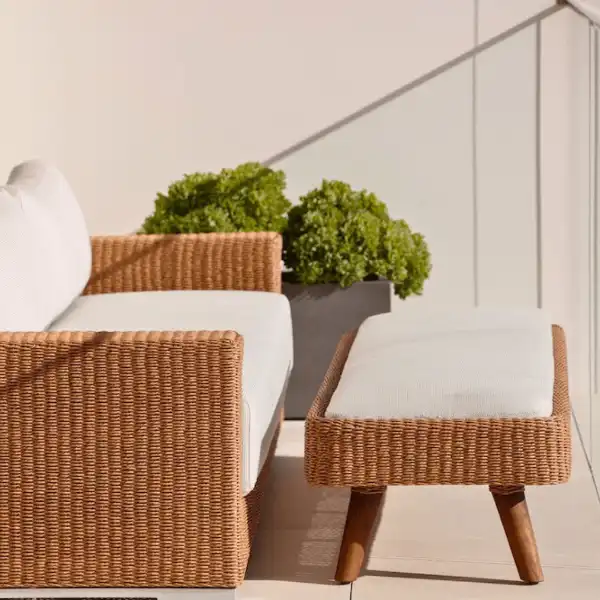
Wicker has enduring appeal in Australian outdoor spaces because it softens architecture and adds a relaxed luxury feel. But quality variation is significant. Premium synthetic fibres designed for outdoor use can handle UV and moisture far better than inferior alternatives, which may crack, stretch or fade prematurely.
Osier Belle specialises in handwoven furniture and uses premium Rehau and Viro synthetic wicker. Rather than relying on the material alone, skilled craftspeople weave each piece at Osier Belle’s own factory, allowing close attention to tension, alignment and the finishing of more intricate forms. The frame beneath the weave remains just as important as the fibre itself. When both are properly engineered, wicker can bring comfort, texture and generosity to lounges, daybeds and dining pieces without sacrificing durability.
Concrete and mixed materials for visual weight
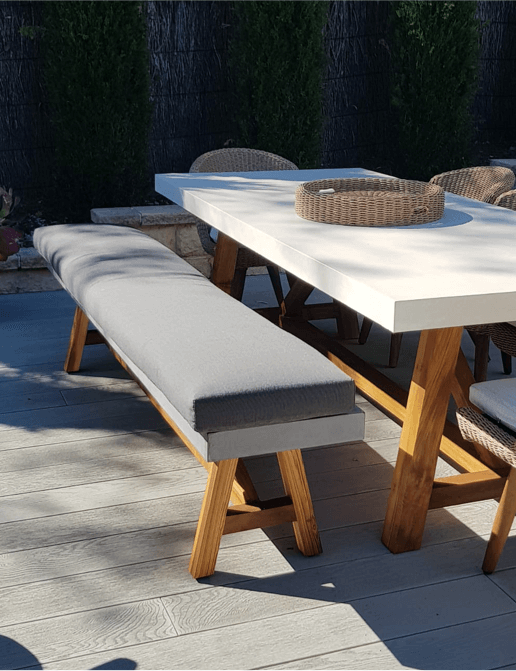
Concrete tables and accent pieces can work exceptionally well in bright conditions, particularly in homes with a coastal, minimalist or resort-inspired palette. They provide visual grounding and architectural presence.
Osier Belle’s concrete tabletops are fibreglass reinforced rather than simply relying on conventional concrete construction. The concrete is also sealed to help repel moisture and staining, making the finishing process particularly important for pieces intended to remain outdoors.
The key consideration is placement, access and scale. A substantial table may be perfect for an open entertaining zone, but less practical for a compact balcony with narrow entry points or stairs.
Mixed-material pieces often offer the strongest design result because they balance different qualities. Concrete can provide architectural weight, teak warmth, wicker texture and upholstery softness. There is no reason a considered outdoor setting needs to choose just one.
Why fabric choice matters as much as the frame
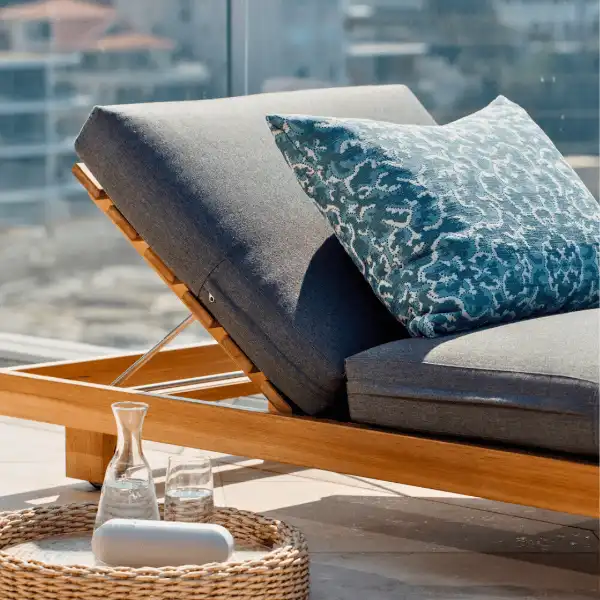
Clients often focus on frames first, but upholstery is where sun damage can become visible fastest. Outdoor fabrics need to resist fading, moisture and mildew while still feeling sophisticated enough for a premium setting. Osier Belle uses 100% solution-dyed acrylic outdoor fabrics, meaning colour forms part of the fibre rather than simply sitting on its surface. With an extensive selection of outdoor fabrics available, the upholstery can also be chosen around the amount of sun a setting receives, its surrounding finishes and how the furniture will actually be used.
Lighter tones tend to feel cooler under direct sun and contribute to a calm, elevated palette. Very pale shades, however, may show everyday marks more readily around pools or high-traffic entertaining areas. Darker tones can be striking but may retain more heat. The right fabric is not simply the most beautiful swatch on a sample hanger, but the one that suits the light, use and maintenance expectations of the space.
Cushion construction is equally important. Osier Belle uses Urecel QuickDry Foam, designed to allow water to drain and air to circulate through the cushion rather than holding moisture after rain or poolside use. In exposed areas, removable covers and practical storage options are worth considering from the outset.
Designing for exposure, not just floorplan
The best outdoor furniture for Australian sun is chosen in response to the exact conditions of the site. A north-facing terrace with no overhead cover will place different demands on furniture than a partially sheltered courtyard framed by walls and planting. Likewise, a rooftop balcony copes with wind in ways a ground-floor entertaining zone may not.
Before selecting a lounge or dining setting, consider how the sun moves across the space, where glare falls in the afternoon, whether surrounding surfaces reflect heat, and how close the furniture will sit to a pool, garden edge or salt-laden air.
Scale matters too. Oversized seating can look luxurious in a generous landscape, but if it leaves little room to circulate around doors, balustrades and pool fences, the space becomes harder to use. Equally, furniture that is too small can make a substantial outdoor zone feel unresolved.
This is where Osier Belle’s custom design process becomes particularly useful. Because pieces are handcrafted at the brand’s own factory, customisation can extend beyond choosing a colour or fabric to adjustments in length, width, height and even cushion thickness, depending on the design. Wicker, fabric and finishes can then be selected around the architecture and conditions of the individual space.
Quality shows up in the details you do not see first
Luxury outdoor furniture earns its place over time. You notice it in the consistency of the weave, the density of the cushion, the precision of the joinery and the way a chair feels stable after years of use. Good design is visible immediately. Good manufacturing reveals itself slowly.
That is why in-house control across design, manufacturing and retail matters. It creates accountability around materials, dimensions, finishes and performance rather than leaving outcomes to disconnected suppliers. For clients investing in a complete outdoor setting, this level of oversight offers something valuable – confidence.
At Osier Belle, that confidence is built into the process as much as the product. Clients are not left to guess whether a piece suits their exposure, architectural style or access constraints. The conversation includes practical details such as lead times, custom options, seat depth, material suitability and how pieces will work together across the entire space.
A better way to buy outdoor furniture for Australian sun
The strongest results usually come from slowing the decision down. Rather than selecting individual pieces based on appearance alone, consider the broader outdoor experience you want to create. Is the area primarily for long lunches, late-night entertaining, poolside lounging or quiet morning coffee? Does it need to feel sculptural and architectural, or soft and relaxed?
Seeing materials in the space itself can help answer those questions. Osier Belle offers take-home samples of wicker, fabrics, timber finishes and concrete options, allowing materials to be considered alongside existing stone, render, joinery and planting – and importantly, under the natural light they will actually live in.
There is rarely a single perfect material or silhouette for every Australian home. The better approach is to choose materials for their position, construction for longevity and proportions for the architecture around them. When those elements align, outdoor furniture can do more than withstand the Australian sun – it can continue to look and feel at home in the space for years to come.
