
A balcony can be the most exacting room in a home. It has a fixed footprint, a view worth preserving and very little margin for furniture that is merely decorative. Luxury balcony furnishing therefore begins with a simple principle: every piece should earn its place through comfort, proportion and material quality.
For an apartment overlooking the harbour, an inner-city balcony or an upper-level coastal retreat, the strongest schemes feel calm rather than crowded. They give the view room, maintain easy circulation and still create somewhere you genuinely want to spend time.
Start with the balcony’s proportions
Before selecting a lounge or dining setting, measure more than the floor area. Record the usable depth from the doors to the balustrade, the width between walls or columns, ceiling height, door swing, drainage points and the location of power outlets. These details decide what will feel effortless to use every day.
Allow a clear route from the interior to the balcony edge. On a narrow balcony, even a beautifully made sofa can become a visual barrier if it projects too far into the walkway. A lower-profile occasional chair and ottoman may offer greater comfort than a full modular arrangement, while preserving a sense of openness.
The view also deserves consideration. If it is the centrepiece, choose furniture with refined, low backs and an open visual profile. Where privacy is more valuable than outlook, a deeper lounge setting, considered planting and a parasol can create a more sheltered room-like setting.
This is an area where Osier Belle’s customisation capability can solve a very specific problem. Suitable furniture can be modified not only in length and width but also in height. We regularly adapt furniture around balcony sightlines and comfortable seating positions rather than asking clients to accept a standard seat position.
Measure access as carefully as the balcony
Premium pieces are designed to last, but they still need to reach the balcony. Check lift dimensions, stair landings, doorway widths and turns through common areas before confirming larger furniture. In some residences, modular components, dining chairs that stack elegantly, or a made-to-order configuration will be the sensible choice.
This is also the time to understand body corporate requirements. Weight limits, fire regulations, rules around fixing items to balustrades and restrictions on parasols can all affect the final design. Planning early prevents a beautiful scheme becoming a complicated delivery day.
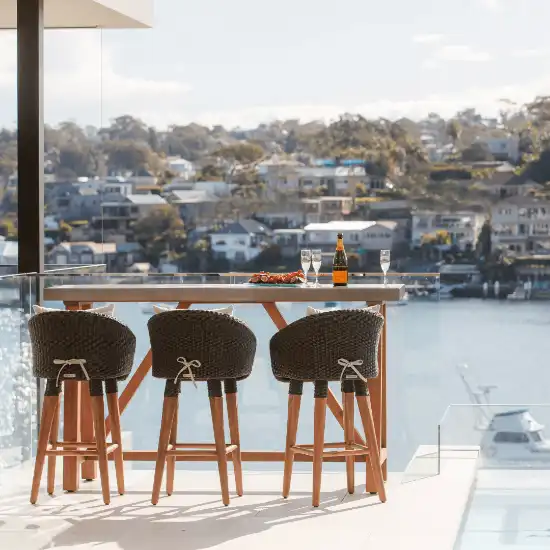
Decide what the balcony is primarily for
A compact balcony cannot usually be a full dining room, lounge and poolside retreat simultaneously.
Choose the main purpose first.
For dining, a round table often improves circulation because it removes hard corners. For lounging, fewer generous pieces can feel far more luxurious than four undersized chairs. A two-seat sofa and ottoman may be all that is needed to create somewhere for a morning coffee or evening drink.
Where the space allows modular furniture, collections such as Joli or Revé can be worth exploring because individual configurations can be considered around the footprint rather than relying on one large fixed sofa.
Choose materials for the Australian climate
A balcony is often more exposed than a ground-level outdoor area. Wind accelerates wear, reflected heat can be intense around glass and concrete, and coastal air introduces salt into the equation. Material selection should respond to these conditions as closely as it responds to the home’s architecture.
Teak brings warmth and natural character to contemporary stone, rendered surfaces and darker architectural palettes. Its weathering is part of its appeal, developing a silvery patina when left untreated. Those who prefer its original golden tone should be prepared to maintain it regularly. Neither choice is wrong – it is a question of the finish you want to live with.
High-quality wicker offers texture and softness without visual heaviness, particularly useful in smaller spaces where solid forms can feel imposing. Osier Belle only use handcrafted woven, UV-stable materials with frames engineered for long-term outdoor exposure. Quality is evident in the tension of the weave, the strength of the structure and the way the furniture retains its shape through changing seasons.
Concrete delivers a grounded, architectural presence, especially in table bases and occasional pieces. It suits modern balconies with robust finishes, but its weight must be considered carefully in apartment settings. Concrete can also retain heat in full sun, so placement and shade are essential.
Upholstery deserves the same scrutiny as the frame. Premium outdoor fabrics should be selected for UV resistance, colourfastness and ease of care, while cushion construction should support lasting comfort and efficient drainage. Pale neutrals can look exceptional in a shaded or covered balcony, but mid-tone mineral shades may be more forgiving in an exposed setting with regular use.
Create comfort without visual clutter
A small outdoor area magnifies every unnecessary object. Prioritise comfort in the pieces that remain. Seat depth, back support and cushion quality have more impact than adding another chair.
Osier Belle uses Urecel QuickDry Foam and solution-dyed acrylic outdoor fabrics so comfort does not need to come at the expense of outdoor performance. Then look for furniture that can perform more than one job. An ottoman can provide a footrest, occasional seat or surface when paired with a tray. Storage can keep cushions and accessories nearby without allowing them to accumulate around the balcony.
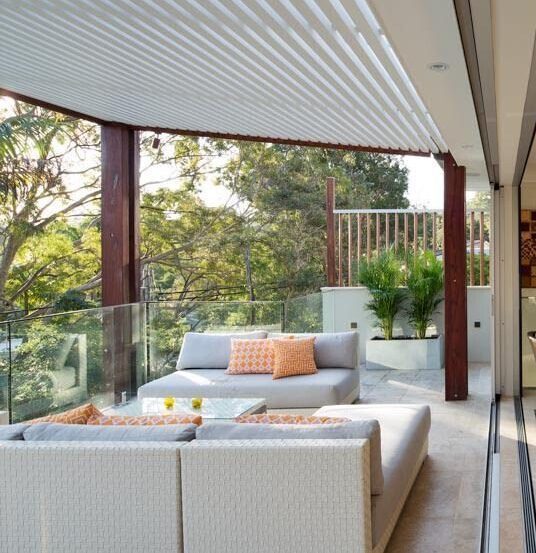
Use colour to connect indoors and out
Because balconies are viewed constantly from inside, their furniture becomes part of the interior composition. Repeat an undertone, timber or shape rather than trying to match every finish precisely.
Osier Belle offers samples of its wicker, fabrics, teak finishes and concrete for clients to take home. This is particularly useful on balconies, where reflected light from glass, walls and neighbouring buildings can change colour dramatically from what you saw in a showroom. Test the material beside the actual flooring and balustrade in morning and afternoon light before making the final choice.
Plan for shade, wind and changing light
On an exposed balcony, a parasol is not simply an accessory. It can determine whether the space is usable in summer. Consider the path of the sun, the available anchoring options and the balcony’s wind exposure before selecting a canopy size or shape. A large parasol may create welcome shade, but it must not overwhelm the setting or become unsafe in strong gusts.
Wind also influences furniture choices. Lightweight loose pieces may be practical to move, yet require regular repositioning in elevated locations. Heavier, carefully engineered furniture gives a sense of permanence, although it needs to align with structural requirements. In very exposed locations, secure cushions and furniture covers are sensible safeguards between uses.
Lighting should support the atmosphere rather than flatten it. Warm, low-level illumination near seating and dining zones extends use into the evening, while candlelight or portable lamps can add a more intimate layer. Avoid harsh overhead light where possible; balconies are at their best when the surrounding cityscape, garden or coastline remains part of the experience.
Invest in fit rather than quantity
Luxury balcony furnishing is rarely about how many pieces will fit. It is about whether the dimensions, comfort and materials allow you to use the space without constantly negotiating around the furniture.
Osier Belle’s combination of made-to-order dimensions, material samples and design consultation is particularly relevant to balconies for exactly that reason. Small changes matter more when every centimetre counts.
A considered balcony should make stepping outside feel easy, preserve what is valuable about the outlook and give the furniture enough space to be appreciated. The goal is not to make a small balcony behave like a large terrace. It is to make the balcony you have work exceptionally well.
