
A well-designed outdoor space in Australia has to do more than look beautiful at midday on a Saturday. It needs to hold its own through hard sun, coastal air, long lunches, wet bathers, late-night entertaining and the daily wear that comes with real living. That is exactly why outdoor furniture trends in 2026 are moving in a more considered direction – less fast styling, more permanence, comfort and architectural intent.
What is changing is not simply colour or silhouette. The larger shift is towards outdoor spaces that feel as resolved as the interiors they connect to. Homeowners, renovators and design professionals are asking more from every piece: visual presence, genuine comfort, material integrity and a layout that responds to the way the space is actually used.
Outdoor furniture trends 2026 are becoming more architectural
The strongest direction for 2026 is an architectural approach to outdoor living. Furniture is no longer being chosen as a finishing touch after the hard landscaping is complete. It is increasingly considered alongside stone selection, pool coping, planting, balustrades and internal finishes.
Profiles are becoming cleaner and more sculptural. Sofas and occasional chairs are taking on lower, more grounded proportions, with generous arms, refined curves and stronger visual weight. Dining settings are also moving away from unnecessary ornamentation towards substantial forms that can hold their own in open-air spaces.
Scale matters more than ever. In larger homes, compact pieces can disappear against expansive terraces or pool surrounds. In smaller courtyards and balconies, oversized settings can make a space feel cluttered and difficult to navigate.
The trend is therefore not simply towards bigger or slimmer furniture. It is towards furniture with the right proportion for the architecture.
Comfort is no longer negotiable
For years, many outdoor settings looked the part but did not invite people to stay. That balance has shifted. One of the most meaningful outdoor furniture trends in 2026 is a stronger emphasis on genuine, living-room-level comfort.
This is showing up in thicker cushioning, supportive seat angles and lounge settings designed for extended use rather than occasional perching. People increasingly expect an outdoor sofa to carry a long conversation, an afternoon beside the pool and the transition into evening entertaining.
There is a design trade-off. Deep, relaxed seating needs room to breathe. In compact spaces, customised dimensions or a carefully edited modular arrangement can deliver comfort without overwhelming the footprint.
This is an area where made-to-order furniture has an advantage over fixed specifications. At Osier Belle, dimensions and even cushion thickness can be adjusted across suitable designs, allowing comfort to be considered against the actual proportions of the terrace rather than accepting a predetermined seat depth.
Softer lines, stronger presence
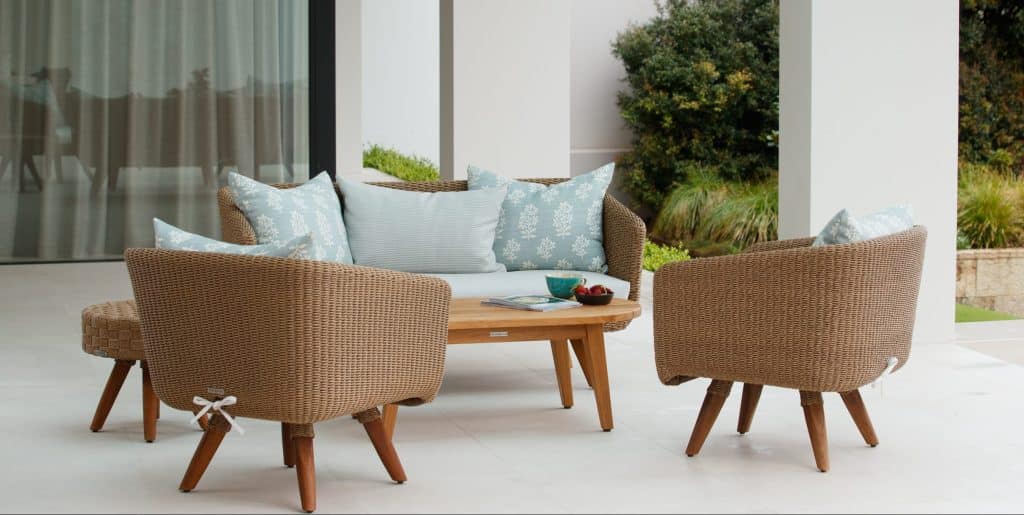
Curves remain influential in 2026, but they are becoming more restrained. Instead of novelty shapes, rounded corners, softened frames and organic forms are bringing warmth to rectilinear architecture.
The Bulle and Tressé collections are good examples of how softer forms can introduce sculptural interest without relying on a short-lived design statement. The aim is furniture that brings another shape into the architecture while still feeling relevant after the trend cycle moves on.
Materials are being judged by performance, not only appearance
Australian buyers have become rightly sceptical of pieces that look impressive in a showroom but fail under UV exposure, salt air or repeated use. Material honesty is therefore central to outdoor furniture trends in 2026.
Teak continues to attract attention because it offers warmth, substance and longevity when properly selected and constructed. Wicker remains equally relevant, particularly in refined contemporary forms, but fibre and frame quality make an enormous difference. Concrete continues to provide sculptural weight for dining and occasional settings.
The better question is no longer simply what material is this? but how has it been made and how will it age?
Osier Belle’s own material palette illustrates the difference. Own furniture incorporates selected teak from Indonesia, Rehau and Viro synthetic wicker handwoven over substantial aluminium frames, solution-dyed acrylic outdoor fabrics, Urecel QuickDry Foam and reinforced concrete. Each material is selected for a specific role rather than relying on a single material to solve every outdoor requirement.
Dining and lounging zones are becoming more deliberate
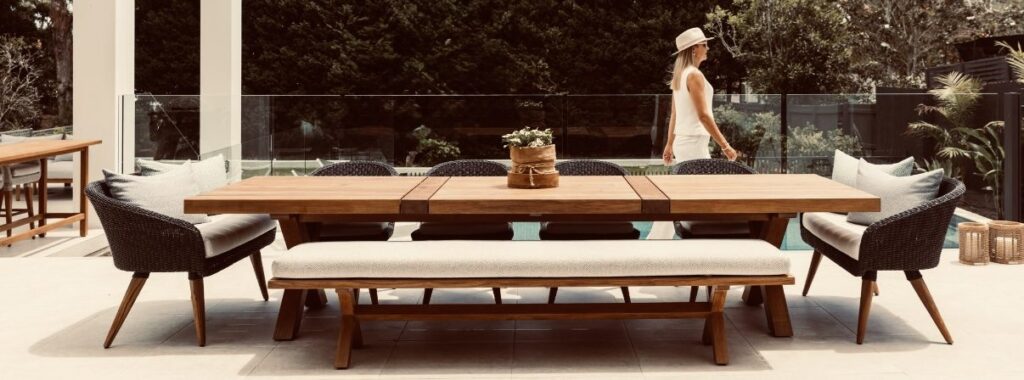
Another clear movement in 2026 is the separation of outdoor zones with greater intention. A dining area might be positioned for long evening entertaining close to the kitchen or barbecue. A lounge setting may orient towards a pool, fire feature or garden outlook. Bar settings, daybeds and sun loungers can create secondary moments rather than simply filling leftover space.
The success of this approach depends on restraint. Not every terrace needs every furniture category. Leaving negative space between zones makes circulation easier and gives individual pieces more visual presence.
Modular design is growing up
Modular outdoor seating is not new, but the way it is being used is becoming more sophisticated. Rather than treating modules as interchangeable blocks, homeowners and designers are using them to resolve unusual footprints, apartment balconies, narrow terraces and expansive poolside settings while maintaining a cohesive form.
Many of Osier Belle’s outdoor lounge collections lend themselves to modular planning, allowing individual components to be configured around the dimensions and orientation of a space. The strongest arrangements still require editing. Good modular design should read as a complete piece when assembled rather than a collection of components pushed together.
Colour is becoming warmer and quieter
The colour direction for 2026 is sophisticated rather than attention-seeking. Warm neutrals, chalky tones, soft mineral shades and natural timber notes are replacing colder greys as the default choice.
Texture is doing more of the work. Handwoven wicker, tactile outdoor fabrics, natural teak grain and matte finishes can add depth without visual noise, allowing architecture, planting and the view to remain part of the composition.
Osier Belle’s broad choice of fabrics and wicker finishes makes this kind of tonal layering particularly effective. Instead of choosing upholstery from a narrow predetermined palette, materials can be considered alongside the home’s stone, timber, render and interior finishes.
Take-home samples of fabrics, wicker, teak finishes and concrete can also be viewed in the home’s actual natural light before committing to a combination – particularly useful when working with nuanced neutrals that can change considerably between showroom and full sun.
Customisation is moving from luxury extra to practical necessity
One of the most significant shifts behind the aesthetics is the rise of customisation. As homes become more design-led and outdoor spaces more integrated with architecture, standard dimensions do not always solve the brief.
Clients are increasingly attentive to seat depth, table length, cushion finish, module configuration and overall footprint. In many homes, practical constraints shape the final outcome just as much as style does. A large sofa may suit the terrace beautifully but still need to navigate a narrow side passage, lift access or a pool fence opening. A dining setting may need to balance entertaining capacity with comfortable clearance around all sides.
This is where premium furniture separates itself from mass production. Tailored options are not about indulgence alone. They are often the difference between a setting that merely fits and one that feels properly resolved. It is one reason design-conscious buyers are gravitating towards brands that control design and manufacturing more closely, including Australian specialists such as Osier Belle.
What these trends really mean for buyers
If there is one idea tying the 2026 trends together, it is that outdoor spaces are being furnished with far more intent. The smartest response is not to chase every new silhouette or colour. It is to use the trends that improve the way a space works: better comfort, materials chosen for longevity, more deliberate zoning, thoughtful modularity and furniture proportioned to its setting.
That approach also reflects something Osier Belle has long prioritised – outdoor furniture should respond to the home and the people using it rather than simply follow what happens to be fashionable. The outdoor settings that will still feel right several years from now are likely to be those where the trend was never the whole point.
