
A straight-lined terrace can feel resolved on a floor plan, yet slightly formal once the entertaining begins. A curved sofa changes that experience. It draws guests towards one another, softens hard architectural edges and gives an outdoor setting a sense of occasion. That is why curved outdoor sofa trends are gaining real momentum in Australian homes, particularly where the outdoors is designed as an extension of the living space rather than a separate destination.
The appeal is not simply visual. A well-proportioned curve makes a large deck, poolside area or rooftop terrace feel more relaxed and considered, while offering generous, sociable seating without the rigid geometry of a conventional modular arrangement. As with any enduring design direction, however, success comes down to scale, construction and how the piece relates to its surroundings.
Why curved outdoor sofa trends have staying power
Curves have returned across residential architecture and interiors: arched openings, rounded islands, sculptural lighting and softer furniture silhouettes. Outdoors, the movement feels especially natural. Landscaped paths, pools, planting beds and horizon lines rarely follow a strict grid, so a curved lounge can create a more intuitive relationship between the built form and the landscape.
There is also a practical advantage. A crescent or gently rounded configuration naturally turns people inwards, making conversation easier across a group. This suits the way Australians entertain, whether it is a long lunch by the pool, drinks at sunset or a quiet family evening on the terrace. Rather than lining everyone up along a wall, the sofa creates a gathering point.
The strongest examples do not rely on novelty. They use a restrained radius, finely detailed frames and cushions with enough depth to invite lingering. The result should feel calm and architectural, not themed or overly theatrical.
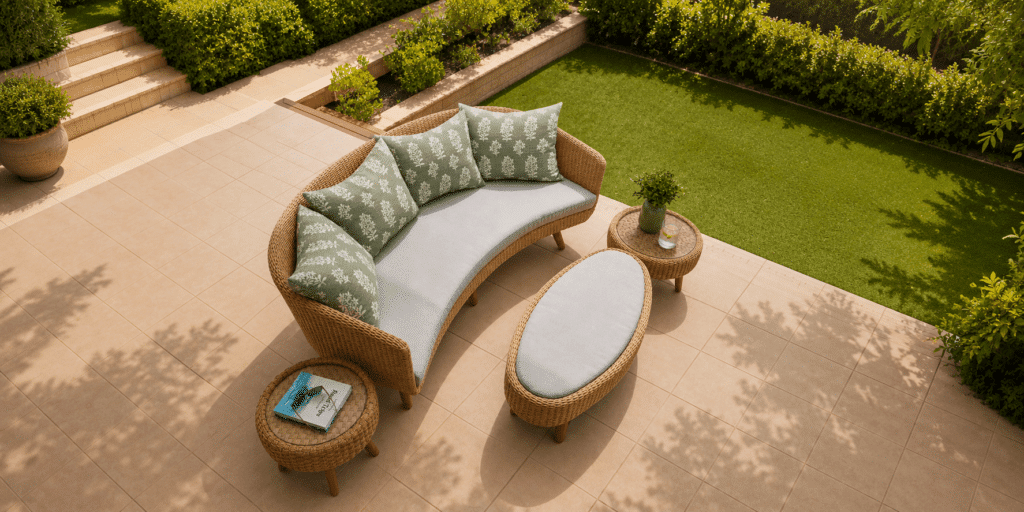
Osier Belle’s Bulle and Tressé collections demonstrate this softer approach to outdoor furniture, using rounded silhouettes and detailed handwoven surfaces to bring curvature into a setting without relying on an exaggerated statement form. The result is furniture that can soften strongly linear architecture while still feeling resolved alongside contemporary Australian homes.

The shift from statement piece to spatial tool
Earlier curved sofas were often treated as a hero object placed in the middle of a room. Current outdoor applications are more sophisticated. Designers are using curvature to solve layout challenges: easing movement around a pool, following the line of a circular fire feature, defining an entertaining zone within a larger deck, or reducing the visual severity of a long retaining wall.
On generous properties, a broad arc can frame a view without blocking it. Facing the curve towards a garden, water outlook or fire feature allows the setting to feel connected to its site. In compact spaces, a shallow curve can be equally effective, provided it does not consume precious circulation room.
This is where a simple floor plan can be misleading. A sofa may fit within the dimensions of a terrace, but still make access to sliding doors, steps, pool gates or balustrades awkward. Consider the route people take while carrying food, moving between indoor and outdoor zones, or supervising children near water. Luxury is not only about appearance. It is the ease with which a space works.
Choosing the right radius
Not every curved sofa needs to be a dramatic half-moon. A subtle radius can soften a setting while retaining the versatility of a linear lounge. For narrower balconies and apartment terraces, this is often the more intelligent choice. It provides a sense of movement without placing the seating too far into the centre of the space.
A deeper curve works best where there is enough clearance around it. As a guide, allow comfortable passage behind or beside the sofa, and make sure coffee tables, occasional chairs and ottomans do not turn the arrangement into an obstacle course. The visual generosity of a curved profile needs physical breathing room.
This is also where made-to-order production becomes useful. Because Osier Belle controls manufacturing through its own factory, suitable designs can be adjusted in dimension to better respond to the available footprint, circulation and surrounding architecture rather than requiring the space to accommodate a fixed standard size.
If the setting is intended for larger gatherings, assess seat capacity rather than overall length alone. Curved segments can look expansive but may offer fewer usable places than a straight modular sofa of similar dimensions. Seat depth, arm width and the angle of each section all matter.
Materials that suit the Australian climate
A curved form asks more of its materials and workmanship than a simple box-shaped sofa. Frames must maintain their shape through heat, moisture and regular use, while upholstery needs to sit neatly around the radius without pulling, bunching or losing its tailored appearance.
For Australian conditions, aluminium frames are valued for their strength, resistance to corrosion and relatively light weight. They are particularly suited to elevated terraces or areas where furniture may need to be moved occasionally. Powder-coated finishes should be selected with the local environment in mind, especially in coastal locations where salt air places additional demands on every exposed surface.
Wicker can bring warmth and texture to a curved silhouette, but the quality of the weave and underlying frame is critical. A refined, UV-stable synthetic fibre can retain its appearance far better than lower-grade alternatives, provided it is paired with sound construction. For Osier Belle’s woven furniture, premium Rehau and Viro synthetic wicker is handwoven by skilled craftspeople at the brand’s own factory. The weave sits over substantial welded aluminium frames, combining the softer appearance required for rounded furniture with the structural support needed for long-term outdoor use. Teak offers another compelling contrast: its natural grain brings an organic quality to contemporary curves, though it will develop a silvery patina if left untreated.
Cushion fabrics deserve equal attention. Look for outdoor textiles engineered to resist fading, moisture and everyday marks, with quick-drying foam designed for the way the furniture will actually be used. Near a pool, in a coastal home or beneath open sky, performance specifications are not an afterthought. They are part of the design brief.
Osier Belle pairs 100% solution-dyed acrylic outdoor fabrics with Urecel QuickDry Foam, helping cushions drain and dry more effectively after rain or poolside use. On curved furniture in particular, careful upholstery and cushion construction are important to maintaining the intended silhouette rather than allowing the form to become loose or uneven over time.
Colour, texture and the return of relaxed refinement
The colour story behind curved outdoor sofa trends is moving away from stark contrast. Warm neutrals, sand, stone, mushroom, clay and softened charcoal allow the form to do the work. These tones sit comfortably against pale limestone, timber decking, concrete and lush planting, and they offer longevity when architecture or accessories evolve.
Texture is becoming more important than obvious pattern. Fine woven surfaces, matte metal finishes, tactile bouclé-inspired outdoor textiles and timber details add depth without competing with the silhouette. The aim is a setting that feels layered and luxurious in daylight, then quietly atmospheric under evening lighting.
This does not mean every outdoor space should be neutral. Deep eucalyptus green, marine blue or terracotta-toned cushions can work beautifully when drawn from the surrounding landscape or architectural palette. The key is restraint. A curved sofa already has presence, so it rarely needs excessive decoration to make an impression.
Pairing a curved sofa with tables and chairs
A round or softly oval coffee table is the natural partner for a curved lounge, as it maintains easy reach from each seat and echoes the flow of the arrangement. Avoid choosing a table merely because it is round, though. Its height and footprint need to support practical use, from drinks and books to shared platters.
Occasional chairs can either follow the curve or create a measured contrast. A pair of sculptural lounge chairs facing the sofa may complete a conversation setting, while a clean-lined dining zone nearby can introduce order and definition. Matching every piece too closely can make an outdoor area feel like a showroom. A considered mix is generally more convincing.
A rounded Bulle sofa, for example, can be balanced by a simple concrete or teak occasional table rather than repeating curves through every piece. This allows the sofa to provide the softer form while the surrounding materials connect it back to the architecture.
When a curved sofa is not the right answer
Curved seating is not universally better. A narrow side terrace, a long rectangular balcony or an area with multiple door openings may be served more effectively by a linear modular design. Straight modules are usually easier to reconfigure, and they can make more efficient use of a tight perimeter.
There is also the question of visual language. Homes with a strongly rectilinear architectural expression can certainly accommodate a curved sofa, but the form should be introduced with intention. A gentle radius, repeated in planters, lighting or a rounded table, will feel more integrated than a single dramatic curve with no connection to the rest of the scheme.
For made-to-order furniture, Osier Belle can also consider access during the design process. Dimensions, configuration and the route through gates, lifts or stairwells should be resolved together- particularly for substantial curved pieces that cannot simply be flat-packed and assembled once outside.
Designing for the years ahead
The most compelling curved outdoor sofas are not selected because they photograph well for one season. They are selected because their proportions suit the architecture, their materials can meet the climate, and their comfort encourages people to use the space often. At Osier Belle, this is where careful consultation matters: understanding the room beyond the room, from sun exposure and access to the way a family likes to gather.
Choose a curve that gives your outdoor area a natural centre, rather than forcing one into place. When shape, scale and craftsmanship are in balance, the result feels less like a trend and more like it has always belonged there. Let’s see what we can create together.
