
A dining table sets the rhythm of an outdoor space. It determines how people move from the kitchen to the terrace, whether a long lunch feels relaxed or cramped, and how the setting looks on the quieter days between celebrations. The choice is not simply between a smaller table and one that becomes larger. A fixed table prioritises visual simplicity and proportions tailored permanently to the space, while an extension table allows the dining area to work differently when more guests arrive. The better option depends on how often those larger gatherings actually happen and how much room you want the table to occupy day to day.
Fixed versus extendable tables: start with the way you live
A fixed outdoor dining table is designed at one enduring size. It is often the more architectural choice, particularly where the dining area has been planned around a specific footprint, view or material palette. The silhouette remains uninterrupted, with no joins or moving parts to distract from the grain of timber, the profile of a base or the calm simplicity of a stone-like top.
For households that regularly seat the same number of people, this certainty is a genuine advantage. A family who dines outdoors most weekends with six people, for instance, may find that a well-proportioned eight-seat fixed table offers the most comfortable everyday setting without the need to adjust anything before guests arrive.
An extendable table brings a different kind of luxury: flexibility without having to maintain a second dining setting. It suits homes where entertaining changes from an intimate midweek meal to a birthday lunch, Christmas gathering or long summer evening with friends. When closed, the table preserves valuable open space. When extended, it gives guests enough elbow room to settle in rather than perch at the edge of a crowded setting.
Neither option is automatically superior. A fixed table rewards decisive space planning; an extendable table responds to a more variable social calendar. The better choice is the one that feels generous in its ordinary use, not only impressive when fully dressed for an occasion.
Why fixed tables make a strong design statement
Fixed tables have a quiet confidence. Their dimensions can be selected to align with pavers, pool lines, built-in benches or the geometry of a pergola, creating a setting that appears integral to the outdoor architecture rather than simply placed within it.
They also allow for bolder material expressions. A substantial teak top or a sculptural concrete form benefits from the visual clarity of a permanent scale. This can be especially effective in larger courtyards, poolside entertaining zones and covered terraces where the dining setting is a focal point from inside the home.
There is a practical argument, too. With no extension leaves, rails or mechanisms, a fixed table is uncomplicated to live with and maintain. This does not make it inherently more durable than a quality extendable design, but it does mean there are fewer components to inspect over time.
The trade-off is space. A table sized for twelve can dominate a setting when only four people are dining. In compact courtyards and balconies, that lost circulation room can affect the enjoyment of the entire area.
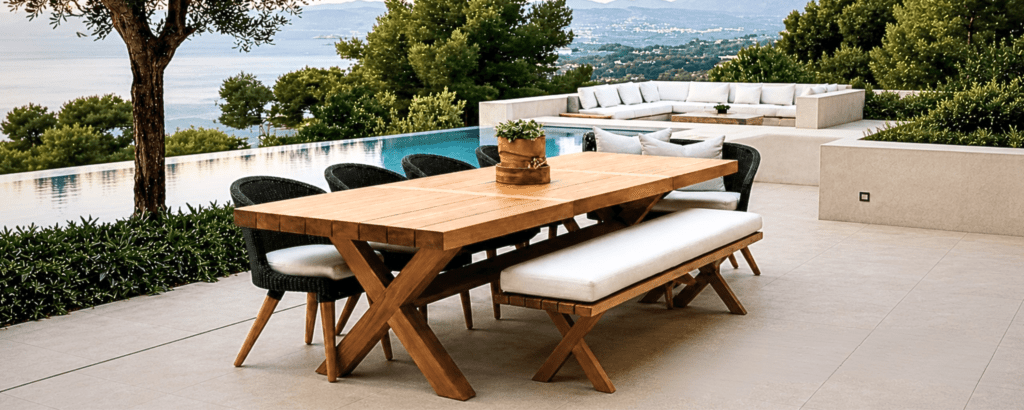
But fixed does not have to mean standard-sized. At Osier Belle, our outdoor dining tables can be made to order in customised lengths, widths and heights. Leg position and end overhang influence where chairs can actually sit and how much knee and foot room guests have. We considers recessed, X-base, tapered, splayed and other leg configurations according to the design, allowing seating capacity and comfort to be considered together rather than treating the base as purely decorative. This can make a fixed table the better solution when the available terrace has very specific proportions or the household regularly entertains roughly the same number of people.
Where extendable tables excel
Extendable tables are particularly well suited to Australian homes built around adaptable entertaining. They can make a smaller terrace feel composed day to day, then accommodate the guests who inevitably gather around a holiday meal or milestone celebration.
The strongest designs do not look like a compromise when closed. Their proportions should feel intentional, with leaves that store neatly or integrate cleanly into the tabletop. Once opened, the extension should provide a stable, level surface and retain the same visual language as the original table.
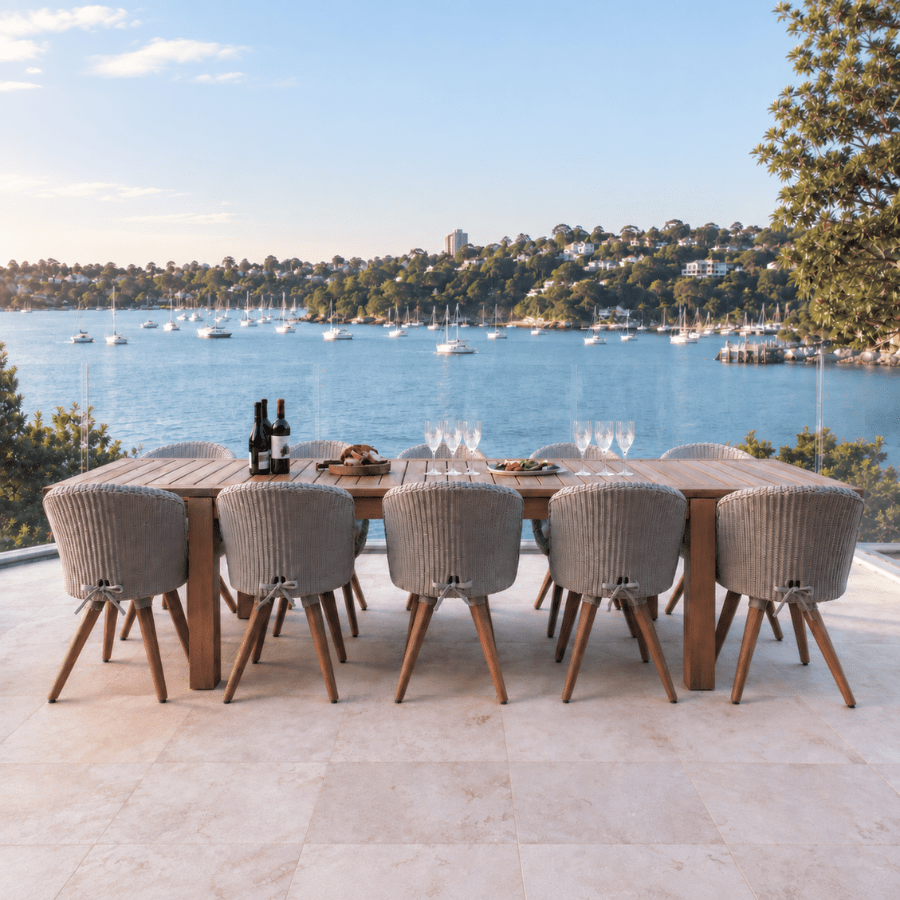
The Osier Belle Outdoor Dining Extension Table demonstrates where this flexibility becomes useful. The solid teak table begins at a generous 220cm for everyday dining and extends to 340cm, accommodating up to 14 people when specified at 110cm wide. Because it is made to order, the table can also be customised around the terrace and preferred entertaining style rather than treating the extension mechanism as the only variable.
Consider how often you will actually extend it. If the answer is several times a month, select a mechanism that is straightforward to operate with one or two people and does not require awkward lifting. If larger gatherings occur only a few times a year, a separate leaf system may be perfectly appropriate, provided there is a dry, protected place to store the leaves.
Plan the table around circulation, not just chair numbers
A table can technically fit within a space and still make the area difficult to use. Begin with the table dimensions in both its closed and extended positions, then map the full footprint of chairs when occupied. The chair depth matters as much as the tabletop length, especially if you are choosing generous dining chairs with arms or cushioned seats.
As a guide, allow around 90 centimetres between the edge of the chair zone and a wall, balustrade, planter or pool fence where possible. More room is preferable behind frequently used seats and along the route between indoor and outdoor entertaining areas. Where this clearance is limited, an extendable table may be the smarter choice because it keeps the everyday layout open.
Choose the shape with purpose
Rectangular tables naturally suit long terraces, outdoor kitchens and dining zones arranged beside a pool. They offer efficient seating and work well when extension leaves are needed. A round fixed table can create a more conversational setting and softens areas with strong architecture, although it usually needs more surrounding clearance than expected.
Oval forms sit between the two. They retain the sociability of a round setting while offering the length needed for larger groups. For an extendable table, the question is whether the expanded shape still sits comfortably within the boundaries of the space. Do not assess the closed dimensions in isolation.
The extension mechanism is a measure of quality
An extendable outdoor table should feel assured, not fiddly. The top must remain level, the mechanism should move without excessive force, and the supporting frame needs to carry the additional span without wobble. Look closely at the alignment of the joins when the table is closed. Fine tolerances and clean transitions signal care in manufacturing.
Material movement deserves attention as well. Outdoor furniture is exposed to heat, rain, humidity and rapid temperature changes. Timber naturally expands and contracts with moisture, while metal components respond differently to temperature. A well-engineered extendable design accounts for these realities through considered joinery, suitable hardware and drainage details that prevent water from sitting where it should not.
For coastal homes, quality fittings are particularly significant. Salt-laden air can be unforgiving, so the finish, hardware and construction method should be selected for the conditions rather than simply for appearance.
Match the material to the setting and your expectations
Teak brings warmth and character to an outdoor dining setting. It works beautifully with limestone, textured renders and established planting, developing a silvery patina if left to weather naturally. For teak tables, precision joinery is essential so the leaves continue to align attractively as the timber responds to the seasons.
Concrete tables bring weight, tactility and sculptural presence. They are generally better suited to fixed formats, where their substantial form becomes part of the landscape composition. They require thoughtful placement, both for structural support and because moving them later is no small task.
Whatever material you prefer, consider the comfort of the full dining experience. A table exposed to western sun may need a parasol or overhead shade. Light-toned surfaces can reduce heat absorption, while timber introduces visual softness where hard architectural materials dominate.
| Fixed outdoor table | Extendable outdoor table | |
|---|---|---|
| Best for | Consistent household/guest numbers | Changing guest numbers |
| Everyday footprint | Permanent | More compact when closed |
| Visual simplicity | Excellent | Mechanism adds complexity |
| Custom sizing | Excellent with made-to-order designs | Available depending on design |
| Large gatherings | Requires permanent table space | Expands when required |
| Best question to ask | “How many do we usually seat?” | “How often do we need extra seats?” |
Let everyday use make the final decision
Picture a normal Saturday morning rather than a styled celebration. Are there four of you having breakfast outside, with doors opening and children or pets moving through the area? A compact extendable table may protect the sense of space. Do you host long lunches often, with the table acting as the permanent heart of the setting?
A fixed table is often the stronger choice when the dining area has room for a permanent setting sized around the way you usually entertain. An extendable table earns its place when guest numbers change regularly and you would rather preserve additional terrace space between larger gatherings.
At Osier Belle, that decision does not have to begin with standard table dimensions. Fixed dining tables can be tailored around length, width, height, leg position and seating requirements, while the Outdoor Dining Extension Table provides another solution for homes that need to move comfortably between everyday dining and entertaining at scale.
